

Selective Laser Sintering (SLS) 3D Printing Service in India
Produce strong nylon parts with SLS for functional prototypes, engineering components, and low-volume production. Champ3D helps Indian businesses move from CAD to finished parts with an online quote workflow and delivery across India.
Support-Free Complex Geometries • PA12 Black • Functional Nylon Parts • Delivery Across India
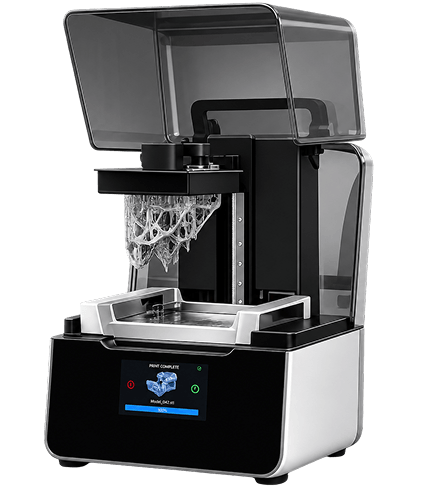
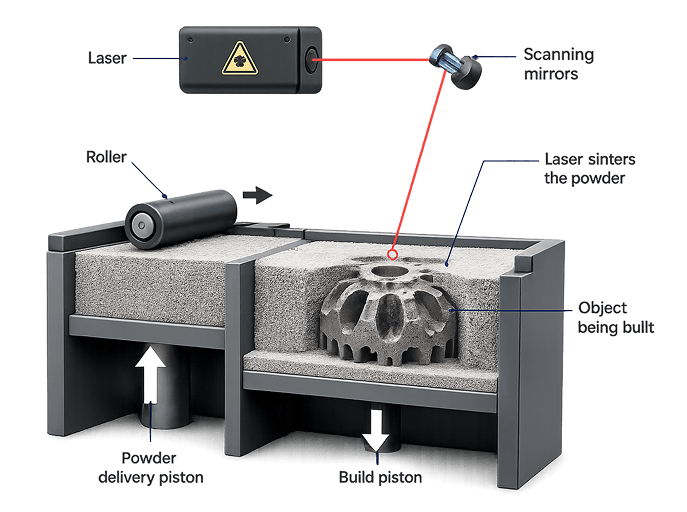
What Is Selective Laser Sintering (SLS)?
Selective Laser Sintering is a powder-bed additive manufacturing process used to build polymer parts from a digital 3D model. A laser selectively fuses thin layers of polymer powder, and the surrounding loose powder supports the part as it is built. This makes SLS well suited to geometries that would otherwise need separate support structures.
For Indian product teams, SLS is especially useful when a project needs functional nylon components, nested parts, internal features, or small production batches without conventional tooling.
Advantages of SLS Printing
No dedicated support structures are usually required because the powder bed supports the geometry during the build.
Complex shapes, internal channels, and nested geometries can be produced more freely than with many support-dependent processes.
PA12 nylon parts can be suitable for fit checks, functional testing, housings, brackets, jigs, and end-use applications depending on design requirements.
SLS is practical for prototypes and low-volume batches because multiple parts can be arranged efficiently within the build volume.
Design revisions can be introduced digitally without changing hard tooling.
SLS 3D Printing Process (Step by Step)
SLS turns a CAD model into a finished nylon part through a controlled powder-bed process. The sequence below explains how the part moves from digital preparation to cleaning.
Ready to price an SLS part?
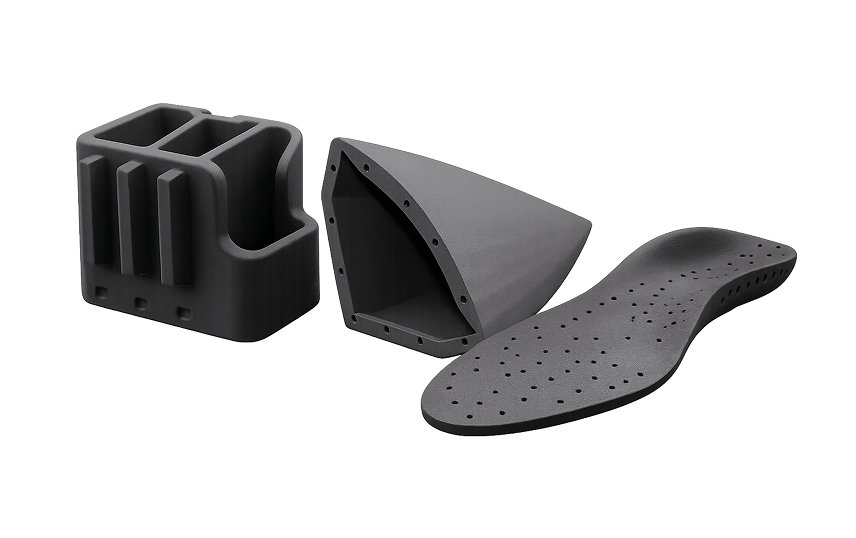
SLS Printing Material
Champ3D currently lists PA12 Black for SLS. PA12 is a nylon material commonly selected for functional components that need a useful balance of strength, low weight, wear resistance, and chemical resistance.
- Strong and durable for many functional applications
- Lightweight compared with many traditional engineering materials
- Good wear resistance for moving or handled components
- Chemical resistance suitable for many industrial environments
- Suitable for complex geometries because no dedicated support structures are generally required
Material selection should still be based on the part load, temperature exposure, environment, required finish, and dimensional needs.
Design Guidelines for SLS Printing
Use these general guidelines as a starting point for SLS part design. Final feasibility depends on geometry, orientation, material, and the specific production setup.
Surface Finishing Options for SLS Printed Parts
Fresh SLS parts usually have a consistent matte texture with a slightly grainy feel from the powder-bed process. Layer lines are generally less visually pronounced than on extrusion-based parts, but the final appearance depends on geometry and finishing requirements.
How Does Champ3D SLS 3D Printing Work in India?
The online ordering flow is designed to move an SLS project from file upload to production with fewer manual steps.
Get Your SLS 3D Printed Parts in 4 Simple Steps
Step 1
Upload your design file
Upload a supported 3D model so the part can be reviewed for size, geometry, and print readiness.
Step 2
Review Pricing and Requirements
Select the available SLS material and project options. Pricing is based on the uploaded model and selected requirements.
Step 3
Confirm SLS Production
After the order is approved, the part is prepared for SLS production and manufacturing begins.
Step 4
Delivery Across India
Finished parts are packed and dispatched to the delivery address selected for the order.
Ready to start an SLS project in India?
Upload your model, review your quote, and move your nylon part into production with Champ3D.
Frequently Asked Questions
Let's Discuss Your Production Needs
Hello! Tell us a bit about your project, and a engineers will follow up to discuss how we can help scale your 3D printed parts from prototype to full production volume.