
Selective Laser Sintering (SLS) 3D Printing Service

Sturdy and durable Selective Laser Sintering 3D printing at an affordable price. Get ultra-smooth, high-detail SLS 3D printed parts for prototypes and production.

Industry-Grade SLS Durable • Prototype Ready Quality • Worldwide Shipping

Parts starting at $2.5/cc

Buy Now
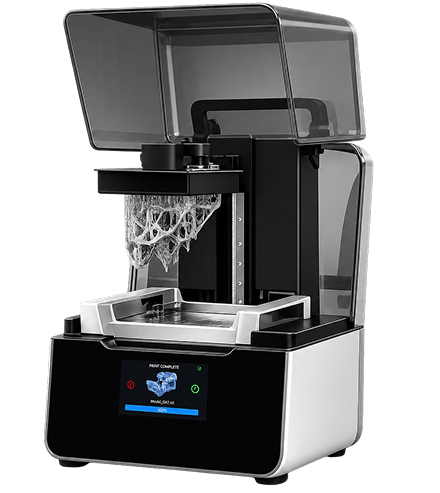
SLS 3D printer with sintered part on build plate
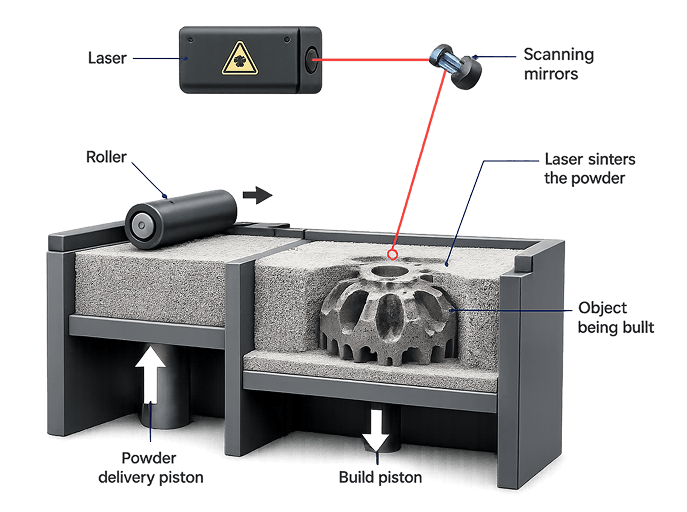
Selective Laser Sintering process diagram showing laser, scanning mirrors, roller, powder bed and build piston

What is Selective Laser Sintering (SLS)?

Selective Laser Sintering (SLS) is a 3D printing technology that uses a high-powered laser to fuse (sinter) fine powder particles, layer by layer, to create a solid object. It is commonly used with nylon and other polymer powders.

Advantages of SLS Printing

It can produce different types of models without any support structure. The surrounding powder itself supports the model.

It can produce complex geometries that cannot be accurately done by other 3D printing methods.

The parts produced by SLS are highly durable, strong, and long-lasting. This is rare in other 3D printing techniques.

It is suitable for prototypes, functional components, and even for end-user parts.

SLS 3D Printing Process (Step by Step)

SLS builds parts by fusing nylon powder with a laser, one layer at a time, with the surrounding powder bed acting as its own support system. Here's what actually happens between hitting "print" and holding a finished part, broken down step by step.
Preparing the
3D Model

A CAD model is created and
sliced into thin layers.

Spread the
Powder

A thin layer of powdered
material is evenly spread
across the build platform.

Laser
Sintering

A laser scans the cross-
section of the first layer,
heating and fusing the
powder particles together.

Lower the Build
Platform

The build platform moves
down by one layer
thickness (typically 0.05–
0.15 mm).

Apply a New Powder
Layer

A roller or blade spreads a
fresh layer of powder over the
previous one.

Repeat
the Process

The laser fuses the next layer.
This cycle continues until the
entire part is completed.

Ready to get your 3D printing quote for SLS Technology?

Upload your 3D file
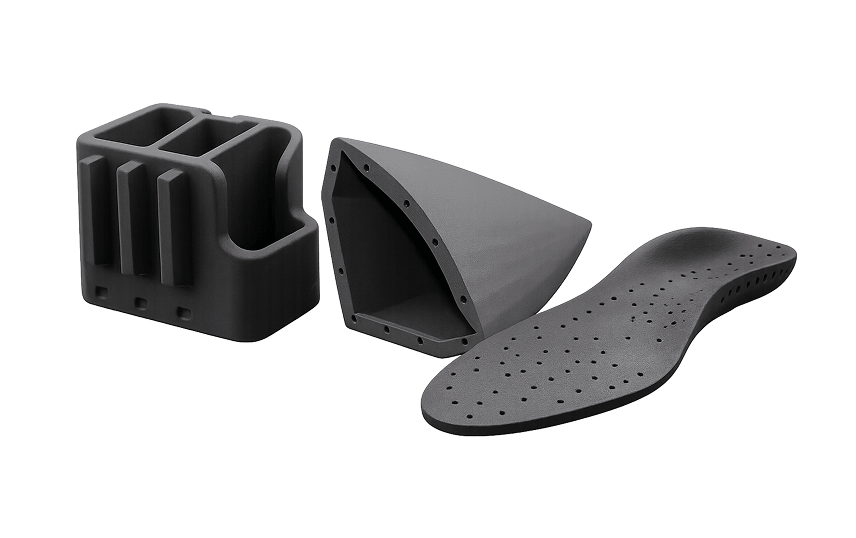
PA12 black nylon SLS 3D printed parts

SLS Printing Material

We at Champ3D use PA12 black which is a nylon material of high quality. It is known for:

  • High strength and durability
  • Flawless dimensional accuracy
  • Chemical Resistance
  • Excellent surface finish
  • Lightweight and wear-and-tear resistant

Design Guidelines for SLS Printing

Here are some general guidelines and SLS 3D printing best practices to follow.

Design Factor
Recommended Guideline
Wall thickness
Minimum 0.8 to 1.0 mm. Ideal 1 mm for normal walls, 1.5 – 2.0 for load-bearing walls.
Internal cavities
escape holes of 5-10 mm diameter
Moving assemblies
tight moving: 0.4 mm, easy moving: 0.6 mm
Texts and logos
For embossed features- height ≥0.5 mm & line width ≥0.5 mm; for engraved features: Depth ≥0.5 mm & Width ≥0.5 mm
Fillets: internal fillets:
≥0.5 mm; external fillets: 1–2 mm where possible

Surface Finishing Options for SLS Printed Parts

SLS 3D printing services produce models with matte, uniform finish that’s slightly grainy. The edges are clean, and the layer lines are not as visible as in SLA or other methods. For your convenience, Champ 3D offers various post-production options to improve the surface finish.

Finish Type
Description
Recommended Use
Production Finish
Minimal post-processing. Support marks may be visible to maintain faster turnaround times.
Internal testing, engineering validation
Refined Finish
Support points are carefully removed and surfaces are lightly sanded for a smoother appearance.
Concept models, functional prototypes
Enhanced Surface Finish
Entire part is finely blasted after sanding for a consistent texture and uniform look.
Client-ready presentations, product demos
Custom Cosmetic Finish
Painting, color matching, masking, clear coating, decals, and texture treatments available.
Miniatures, action figures, display models, toy samples

How Does SLS 3D Printing Service from Champ 3D Work?

Using the SLS 3D printing service from Champ 3D is simple and fast.

Get Your SLS 3d Printed Parts in 4 Simple Steps

  • Step 1

    Upload your
    design file

    Upload your 3D file in one of the many
    supported file formats.

  • Step 2

    Instant File
    Analysis & Quote

    Receive an instant price quote depending on
    the size, complexity, and other aspects of your
    design.

  • Step 3

    SLS
    Productions

    Once approved, your SLS part enters
    production using advanced SLS 3D printing
    technology

  • Step 4

    Confirm order
    and delivery

    Once you’re happy with the quote,
    confirm your order. We’ll get it
    printed and then deliver it to your
    doorstep.

Ready to start with SLS 3d Printing Technology?

Upload your file today and experience professional-grade SLS 3d printing built for serious creators and engineering teams.

Get a 3D Printing Quote

Frequently Asked Questions

Selective Laser Sintering (SLS) is an advanced 3D printing technology that uses a high-powered laser to fuse powdered nylon or other polymer materials into strong, functional parts. SLS technology is very helpful for producing complex geometries without additional support structures.