
FDM vs. SLA for Custom Product Enclosures: Cost, Strength, Finish & Accuracy Compared
Listen to Content
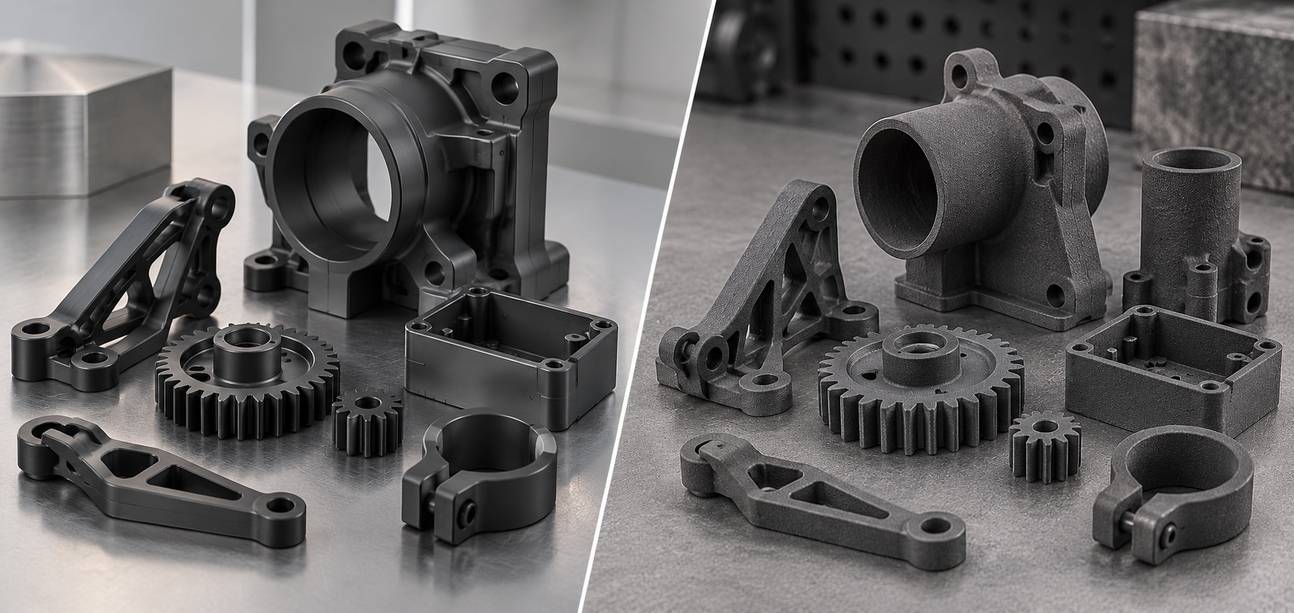
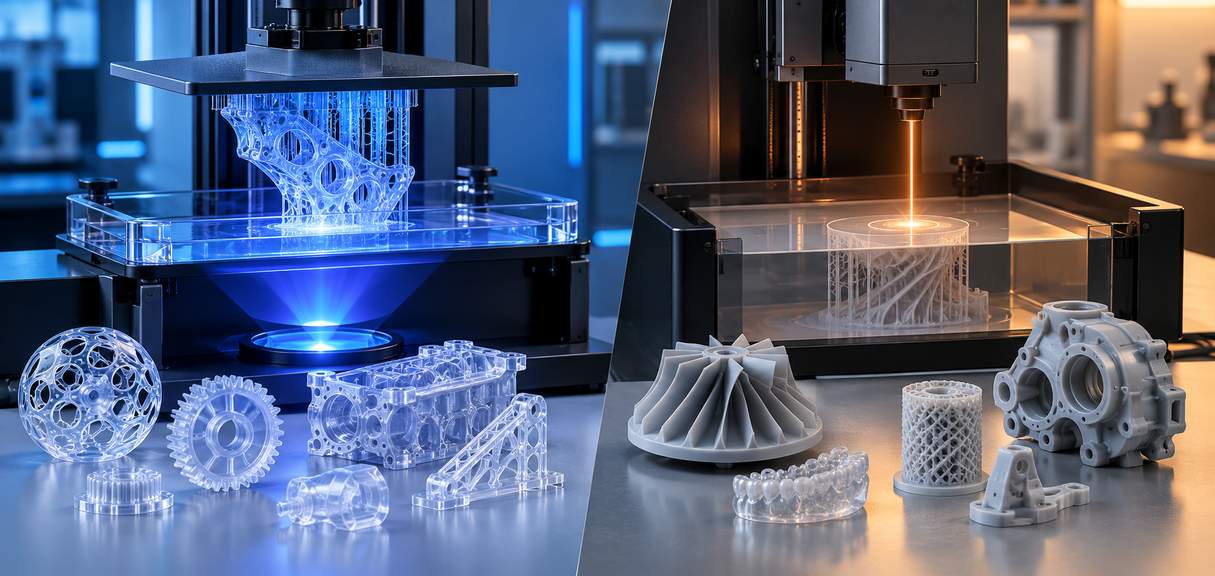
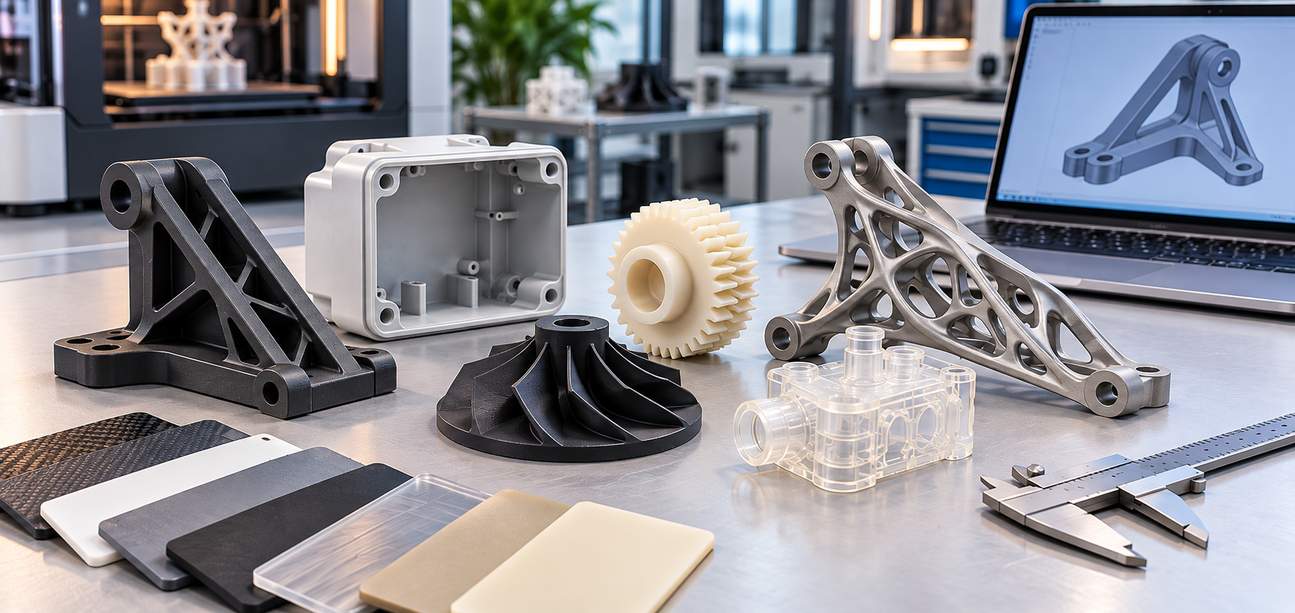
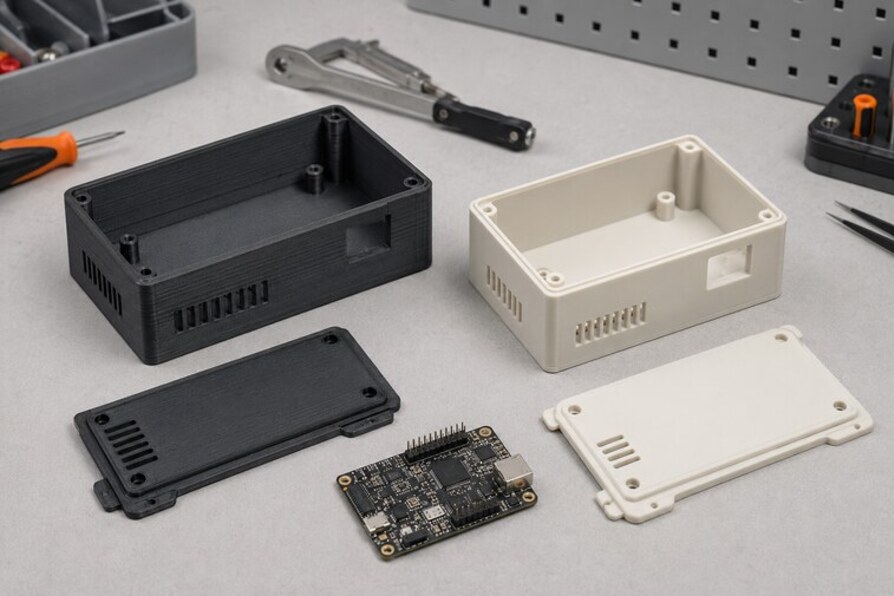
FDM and SLA differ in four decision-relevant ways for a 3D printing enclosure: cost per part, mechanical strength, surface finish, and dimensional accuracy. FDM is usually the practical choice for larger structural housings, impact-conscious prototypes, and cost-sensitive iterations, whereas SLA is better suited to compact, consumer-facing enclosures that need smooth surfaces, fine details, and close-fitting features. The right process depends on what the enclosure must do, not simply which technology produces the most attractive sample.
FDM vs. SLA: Quick Comparison Table
|
Attribute |
FDM |
SLA |
|
Cost |
Often economical for larger, structural, or iteration-heavy parts |
Best justified when fine detail or reduced cosmetic finishing matters |
|
Strength |
Engineering thermoplastics; orientation affects layer adhesion |
Resin behavior varies; select a functional resin for loaded features |
|
Finish |
Visible layer lines unless further finished |
Smoother surfaces and finer details directly from the process |
|
Accuracy |
Typical published tolerance: +/-0.2 to +/-0.5 mm |
Typical published tolerance: +/-0.1 to +/-0.2 mm |
Published tolerances vary with geometry, material, orientation, and post-processing.
Cost: FDM vs. SLA for Enclosures
An FDM vs. SLA 3D printing cost comparison starts with part volume. Enclosures often have broad walls, deep cavities, and a footprint much larger than their mass suggests. FDM deposits thermoplastic only where the toolpath and infill require it, so engineers can balance wall count, infill, and internal ribs. That makes FDM a strong candidate for large housings and repeated fit-check prototypes.
SLA builds with liquid photopolymer resin and normally requires supports, washing, and post-curing. A hollow enclosure can reduce resin use, but it needs suitable walls and drainage holes. Champ3D advises hollowing SLA parts thicker than 20 mm and using at least two drainage holes of 2 mm or more.
Actual pricing still depends on material, dimensions, orientation, quantity, support requirements, and finish. FDM may cost less for a large function-first housing, but a small SLA shell that needs little cosmetic work can be the better total-value option. Upload the same CAD file under each process to compare project-specific quotes instead of relying on a fixed percentage claim. This makes it easy to see exactly how FDM 3D printing pricing compares to SLA for your specific enclosure design.
Strength & Durability
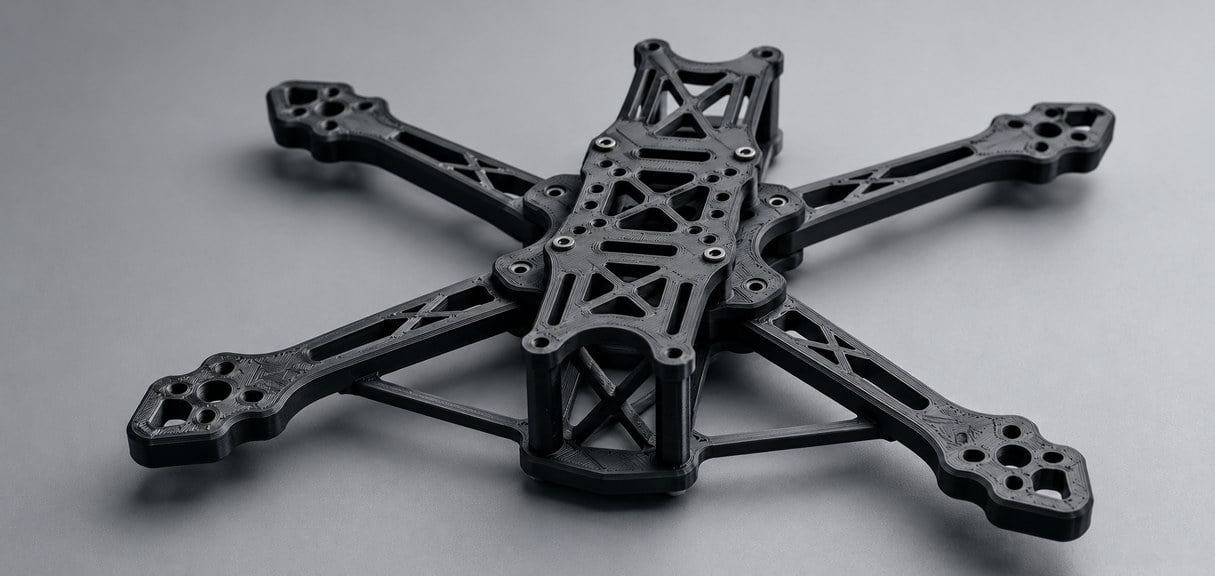
For resin vs. FDM strength, the material and build direction matter as much as the printer type. FDM uses thermoplastics such as PLA, ABS, PETG, nylon, TPU, ASA, and polycarbonate. Champ3D identifies FDM as suitable for durable housings and working prototypes, but its layer-by-layer extrusion creates directional strength. Loads that pull layers apart can expose weaker layer adhesion, so orientation should follow the main load path.
That makes FDM useful for housings expected to face handling, drops, repeated assembly, or mechanical loading. Screw bosses need adequate wall support and often threaded inserts for repeated fastening. Snap-fits should be aligned so the flexing arm is not easily split along layer boundaries.
SLA resins offer different behavior. Champ3D lists rigid white resin for fine-detail prototypes and green resin for snap-fit parts, light flexibility, and functional testing. A standard rigid resin may be less forgiving under impact than a suitable engineering thermoplastic. Do not treat SLA vs. FDM strength as one universal ranking: match the resin or filament to the drop, heat, UV, chemical, and fastening demands of the enclosure.
Surface Finish & Cosmetic Quality
The SLA vs. FDM surface finish comparison is usually clearest on curved shells, front bezels, button openings, and branded surfaces. FDM parts show visible layer lines because heated filament is deposited in stacked paths. Fine layers can reduce the effect, but sloped and rounded surfaces may still reveal stepping. An as-printed finish is often acceptable for internal housings, engineering checks, and early prototypes.
Champ3D offers FDM finishing options that include support removal, sanding, vapor smoothing for compatible ABS or ASA parts, priming, and paint preparation. Added finishing changes lead time and cost. Designers should account for material removal when a mating surface will be heavily sanded.
SLA produces smoother surfaces, sharp edges, and finer visual detail directly from the printing process. Champ3D's SLA options include production, refined, enhanced, and custom cosmetic finishes, with services such as light sanding, blasting, painting, color matching, clear coating, decals, and texture treatments. Choose SLA when the 3D printing surface finish is central to a client demo, photography sample, display unit, or consumer-product evaluation.
Dimensional Accuracy & Tolerances
Accuracy becomes critical where a lid meets a base, a connector passes through a wall, or a PCB must align with bosses and ports. Champ3D publishes typical industrial FDM tolerances of +/-0.2 to +/-0.5 mm, depending on geometry, material, and orientation. Its published SLA range is tighter at +/-0.1 to +/-0.2 mm, also subject to geometry, resin, and post-processing.
Those ranges explain why SLA often suits compact 3D printed electronics enclosure designs with fine apertures, narrow seams, small lettering, and detailed button features. FDM can still produce accurate functional housings, but mating clearances should allow for extrusion width, layer direction, corner behavior, and possible warping across large flat walls. Ribs, chamfers, and a suitable orientation can improve stability.
Never apply one clearance value to every feature. Snap-fits, sliding joints, screw holes, and gasket channels behave differently. Print a tolerance coupon or one critical section before committing to a batch. Sanding, coating, or paint also changes dimensions, so identify mating surfaces when requesting a quote.
Which Should You Choose? A Decision Guide
Choose the process by enclosure duty, not by a blanket SLA vs. FDM rule. Use this starting point, then validate the chosen material and critical features with a prototype.
Large functional prototype - FDM: Lower-cost iteration, large-format capability, and engineering thermoplastics.
Drop-conscious handheld housing - FDM: Material choice and build orientation can support impact and repeated handling.
Compact consumer-electronics prototype - SLA: Smooth surfaces, fine apertures, and tighter published tolerances.
Display or photography model - SLA: High detail and reduced finishing work for cosmetic surfaces.
Painted presentation enclosure - Either: Choose FDM for size and thermoplastic needs; SLA for fine detail and a smoother base.
Fit-check with several design revisions - FDM: Cost-efficient prototyping can make repeated large-part iterations practical.
Frequently Asked Questions
Can FDM and SLA parts be used in the same enclosure assembly?
Yes. A project can use an FDM structural base and an SLA bezel, button, lens surround, or detailed insert. Define process-specific clearances, include reliable locating features, and test the mating parts before production.
Does Champ3D offer FDM and SLA for the same uploaded design?
Champ3D offers each process through its online ordering platform. Upload the enclosure file and compare the available material, finish, production, and pricing options for the design.
Should screw threads be printed directly into an enclosure?
Large, lightly used threads may be printable, but repeated assembly often benefits from heat-set inserts, captured nuts, or another fastening method. Boss dimensions, wall support, material, and print direction should be reviewed before ordering.
Move From CAD to a Project-Specific Quote
Use Champ3D's custom enclosure 3D printing service to upload the same design and review the available production options. You can also compare the dedicated FDM 3D Printing and SLA 3D Printing service pages before ordering.