DLP vs. SLA 3D Printing: Key Differences Explained
Listen to Content
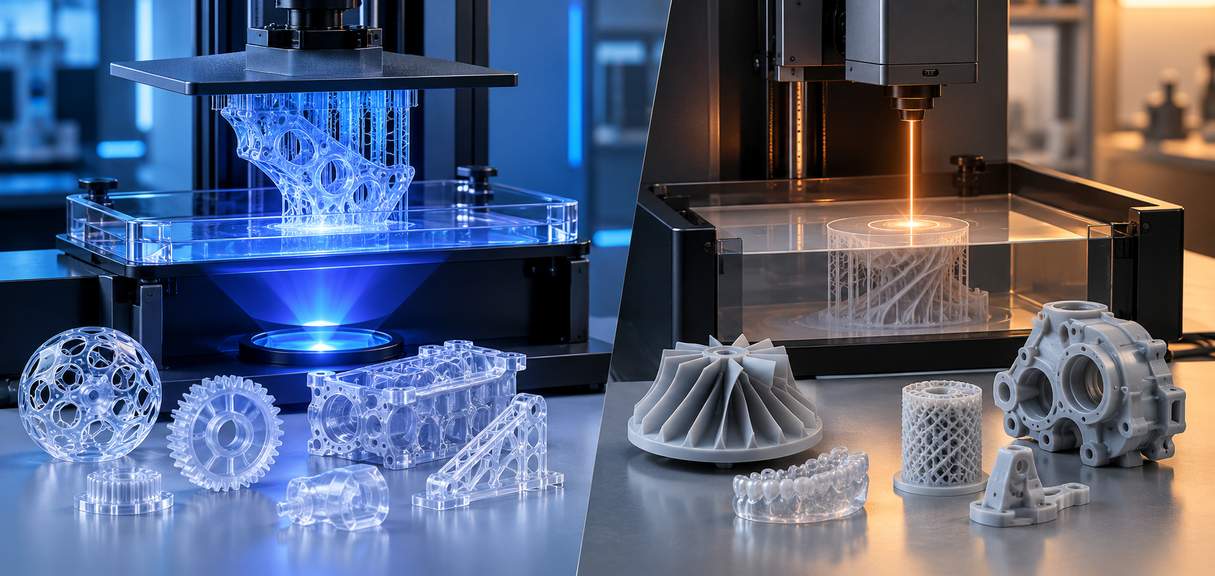
When comparing DLP vs. SLA, the core distinction is that both are vat photopolymerization processes that cure liquid resin using light, but DLP projects an entire layer of the part at once, while SLA traces each layer point by point with a focused laser beam.
Whether you're weighing SLA vs. DLP for prototypes, dental models, or production parts, both SLA 3D printing and DLP 3D printing deliver excellent detail. This article compares light source, speed, accuracy, finish, and cost.
What Is DLP (Digital Light Processing) 3D Printing?
DLP 3D printing, short for digital light processing 3D printing, is a vat photopolymerization process that uses a digital projector to cure liquid photopolymer resin layer by layer, producing solid, highly detailed parts from a vat of light-sensitive material for prototyping, dental, and manufacturing applications.
A digital micromirror device (DMD) inside the projector cures an entire cross-section of resin in a single exposure, rather than tracing it point by point. DLP printing is popular for small, intricate parts such as dental models, jewelry patterns, and miniatures.
What Is SLA (Stereolithography) 3D Printing?
SLA 3D printing, short for stereolithography, is a vat photopolymerization process in which an ultraviolet laser cures liquid photopolymer resin layer by layer inside a vat, building solid, accurate parts with smooth surfaces and fine detail directly from a digital design.
The laser traces and cures each layer point by point, guided by mirrors. It is a proven technology for cosmetic prototypes, molds, and end-use parts, and Champ3D's SLA 3D printing service offers it across a range of materials.
SLA Resin Printing Materials
SLA resin printing supports standard, tough, flexible, castable, and biocompatible resins, so you can match the material to the job, from visual models to functional parts.
DLP vs. SLA: Key Differences
Comparing SLA vs. DLP 3D printing comes down to how light reaches the resin, and that one choice shapes everything else.
-
Light source: DLP uses a projector that exposes a full layer at once. SLA uses a laser that draws each layer.
-
Speed: Flashing a whole layer is usually quicker than tracing it, so DLP tends to pull ahead as more parts fill the platform.
-
Accuracy: DLP detail is set by projector pixel size, while SLA detail is set by laser spot size.
-
Surface finish: Both produce smooth parts, though SLA is often slightly smoother on curves.
-
Cost: Small-format DLP machines are often more affordable, while large-format SLA costs more but handles bigger parts.
This DLP vs. SLA 3D printing comparison is a general guide. Real results depend on the machine, resin, and settings.
DLP vs. SLA: Quick Comparison Table
|
Attribute |
DLP |
SLA |
|---|---|---|
|
Light Source |
Digital projector (DMD) |
UV laser |
|
Speed |
Faster; whole layer at once |
Slower; laser traces layer |
|
Accuracy |
High; set by pixel size |
High; set by laser spot size |
|
Surface Finish |
Fine; faint pixel lines possible |
Very smooth |
|
Best Suited For |
Small, detailed parts; batches |
Larger parts; cosmetic finish |
Exact figures vary by machine, resin, and part geometry, so treat this table as a general guide rather than fixed values.
Which Should You Choose: DLP or SLA?
The single biggest deciding factor is usually the trade-off between batch throughput and part size: choose DLP when you need many small, detailed parts printed quickly, and choose SLA when you need larger parts or the smoothest possible surface finish across the build.
Beyond that, match the process to your use case:
-
Choose DLP for small, high-detail parts, batch runs, and tighter budgets.
-
Choose SLA for larger parts, cosmetic surfaces, and consistent accuracy across the whole build area.
If your parts are large, functional, or cost-driven, FDM 3D printing may fit better. Our FDM vs. SLA comparison explains when.
DLP vs. SLA FAQs
Is DLP faster than SLA?
Often, yes. DLP cures a full layer in one exposure, so layer time barely changes with the number of parts. SLA must trace every part, so time grows with the area cured. High-speed SLA systems can narrow the gap on single parts.
Does DLP or SLA produce a smoother surface finish?
SLA usually has a slight edge. DLP builds layers from square pixels, which can leave faint patterns on curved surfaces, though smaller pixels and anti-aliasing reduce this. Either way, cosmetic parts typically need washing, curing, and light sanding.
Which is more accurate: DLP or SLA?
Neither wins outright. DLP resolution is fixed by pixel size, so it is finest on small builds and coarser as the build area grows. SLA laser spot size stays consistent across the platform. Both typically hold tolerances within a fraction of a millimeter.
Can DLP and SLA use the same resin?
Sometimes, but not reliably. Resins are formulated for specific light wavelengths and exposure settings, and DLP and SLA machines often use different ones. Always use resins validated for your printer.
Get an Instant Quote for Your Resin 3D Printed Part
Not sure which process suits your design? Upload your file to get an instant quote and compare options. Champ3D makes it easy to go from CAD file to finished resin part through our online 3D printing services.